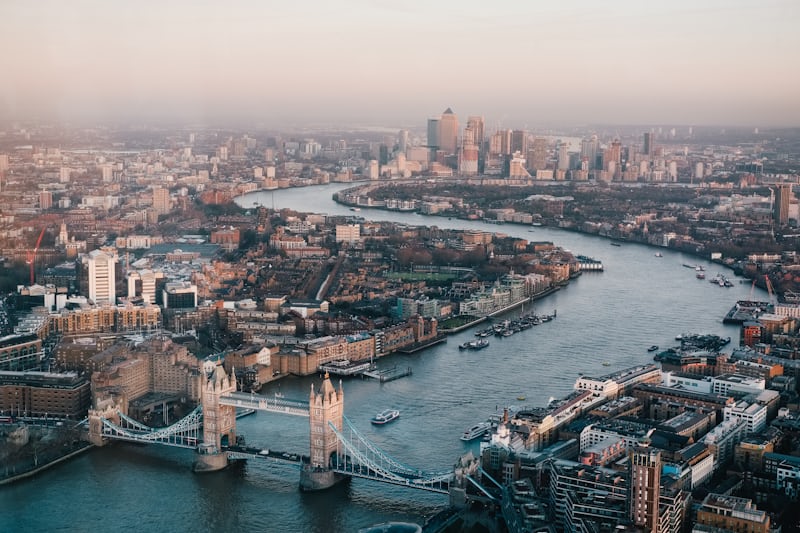
The Thames divides London north and south, and crossing it is one of the quiet challenges of getting around the capital — the crossings are fewer than you'd think, they bottleneck at peak times, and choosing the wrong one can add half an hour to a journey. This guide explains London's river crossings, why they cause delays, and how a knowledgeable taxi driver picks the smart route across.
London grew up around the Thames, and the river remains a genuine barrier to movement. Central London has a good cluster of bridges, but east of Tower Bridge the crossings thin out dramatically — a fact that catches out many drivers and causes serious congestion at the few available points. Getting a river crossing right can be the difference between a smooth journey and a frustrating crawl, especially for cross-river airport runs.
A good number of bridges serve central London — Westminster, Waterloo, Blackfriars, Tower Bridge and more — giving flexibility in the middle of the city.
East of Tower Bridge, crossings are scarce — the Rotherhithe and Blackwall tunnels and the Dartford Crossing carry heavy loads and bottleneck badly.
West of the centre, bridges like Putney, Wandsworth and Chiswick serve the south-west but congest at peak times.
This is exactly where local knowledge earns its value. An experienced London driver knows which crossings suit which journeys, when each is likely to jam, and how to adapt when an incident closes a bridge or tunnel. Rather than blindly following a sat-nav to the nearest crossing — which may be gridlocked — a knowledgeable driver weighs the options and picks the route that's genuinely fastest, factoring in the time of day and current conditions. For cross-river journeys, that judgement can save significant time.
Many airport runs involve crossing the river — our fixed fares cover it whatever the route:
| From | Saloon | Executive | MPV | 8-Seater |
|---|---|---|---|---|
| London City Airport | £91 | £101 | £103 | £111 |
| Heathrow Airport | £98 | £110 | £112 | £120 |
| Gatwick Airport | £123 | £142 | £146 | £158 |
| Luton Airport | £110 | £130 | £133 | £143 |
| Stansted Airport | £113 | £133 | £136 | £146 |
Fixed fares mean the price is agreed upfront regardless of which crossing the driver uses — no meter ticking in river-crossing traffic.
A: Crossings are limited — especially in east London — so traffic funnels through few points and bottlenecks, particularly at peak times.
A: Yes — an experienced driver picks the crossing and route that's genuinely fastest for the conditions, not just the nearest.
A: No — our fares are fixed, agreed upfront, so traffic doesn't increase the price.
A: The east London tunnels (Blackwall, Rotherhithe) carry heavy loads and jam frequently.
Crossing the Thames is a real factor in London journeys — the crossings are limited and bottleneck, especially in the east. A knowledgeable driver picks the smart route across, and with fixed fares, the price stays the same however the traffic flows. That local judgement is part of what you're booking.
Local drivers, smart routes across the river — fixed fares.
Book Now →